Prisma is the "easier" tool. Drizzle is the "flexible" and "high-performance" tool.
1. Setup & Ease of Use
Prisma wins on day one.
You run npx prisma init, write your model, run prisma db push, and you are off to the races.
The setup is easy and beginner-friendly.
Drizzle requires a bit more boilerplate up front.
Because of its flexibility.
You have to configure your database driver (Postgres, Neon, PlanetScale, Turso) manually, set up Drizzle Kit, and wire up client files.
It takes a few extra minutes, but you gain total control over your database connection pool.
2. Schema Definitions
With Prisma, your database schema lives in a custom .prisma DSL file.
It's a totally different language designed by Prisma.
It is clean, highly readable, and handles relations out of the box:
With Drizzle, your schema is 100% standard TypeScript.
No custom syntax or extra DSL language to learn:
Drizzle requires a few more lines to define models and relations.
However, avoiding a custom schema syntax is a major benefit for TypeScript purists.
3. Querying Data & Relational Control
Prisma excels at handling complex relations automatically with
prisma.user.findMany({ include: { posts: true } }).
You don't have to write manual joins.
But when you need custom SQL queries or window functions, Prisma restricts you to its built-in API.
This is where Drizzle shines when you need raw SQL control while retaining complete type safety.
You can query using db.query for relational models
or use raw SQL builders (db.select().from(...)) for maximum query precision.
4. Performance & Serverless Cold Starts
This is where the architectural split becomes obvious.
Prisma compiles queries through a Rust query engine binary.
In traditional Node servers, it works great.
But in serverless environments (Vercel, AWS Lambda, Cloudflare Workers), that binary footprint can add noticeable cold start latency.
Your Vercel app might become slower because of its cold start nature.
Whereas Drizzle is designed for speed.
It creates a paper-thin abstraction layer over native database drivers.
Zero binary overhead means cold starts are virtually instant.
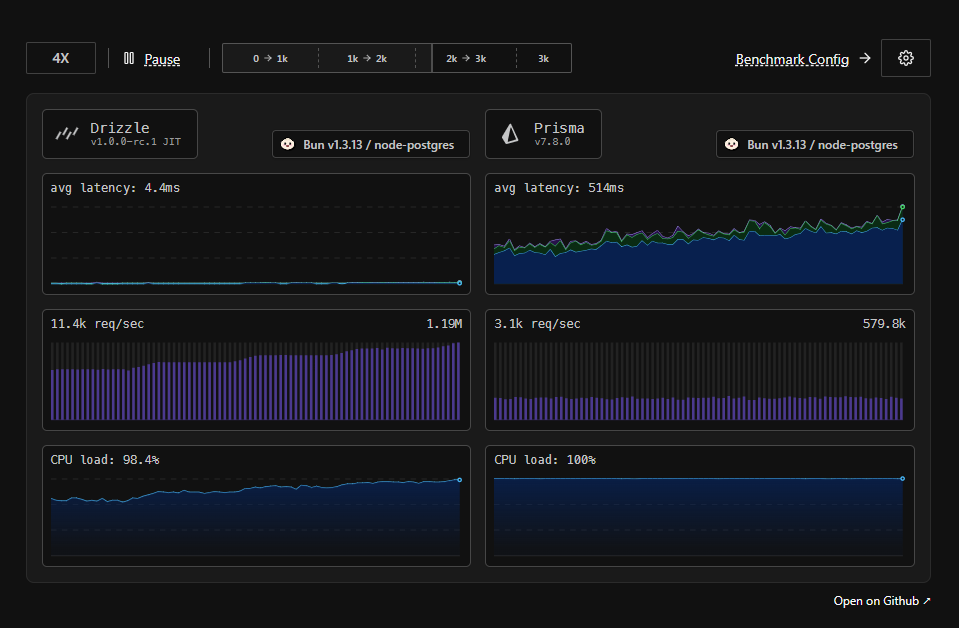
For example, you can visit their Benchmarks page for more clarity on how they have optimized it.
5. Type Safety
Both libraries provide top-tier TypeScript support, but their implementations differ slightly:
- Prisma generates static types from your
.prismafile usingprisma generate. - Drizzle infers types directly from your TypeScript schema objects (
InferSelectModel), eliminating code generation steps.
Decision Matrix: Which one should you pick?
| Feature / Criteria | Prisma | Drizzle |
|---|---|---|
| Best For | Rapid prototyping, standard CRUD apps, easy setup | High performance, serverless/edge, SQL control |
| Schema Definition | Custom .prisma DSL | Pure TypeScript schemas |
| Performance & Cold Starts | Higher latency (Rust binary engine) | Instant cold starts (Zero binary overhead) |
| Query Flexibility | Built-in relational API (restricted raw SQL) | Complete SQL builder + relational queries |
| Type Safety | Code-generated (prisma generate) | Inferred directly from TypeScript |
| Setup Experience | Super easy (npx prisma init) | Manual driver & client setup |
Final Verdict
Ultimately, Prisma is the easier tool for getting started fast, while Drizzle is the flexible and high-performance tool for long-term control.
Pick the right tool for your latency requirements and ship.
Thank you for reading 💖